
When implementing a Child Safeguarding System a question arises inside the teams and the organisations: “Will we detect more cases?” The answer has two parts. Yes, more cases are detected (and the worries about being able to address all of them adequately is real), but those cases are not necessarily situations of violence caused by their staff (which is a big relief for those in charge of Child Safeguarding). Indeed, if all the groups of professionals are better trained and besides there are Child Safeguarding officers and structures, It is normal for more concerning circumstances to be identified. Those situations can be related to situations of violence, but, when a system like this is in place, they are not usually created by their staff, but they are usually caused by peers or children and young people experience them in other spaces and ask for help inside the system. However, requests can be made regarding other type of situations, like mental health.
FC Barcelona and the FC Barcelona Foundation have experienced this precisely, and they have taken the most adequate stance. “What do we do when mental health issues appear? We address them too, of course.” I have felt honoured to accompany their teams in decision making and to write these two key tools: the Position Statement and the Mental Health Protocol.
- Download the FC Barcelona and the FC Barcelona Foundation’s Position Statement and the Mental Health Protocol in English from their Child Safeguarding website.
- Descargar el Posicionamiento y el Protocolo de Salud Mental del FC Barcelona y la Fundación FC Barcelona en castellano de su página web de Protección de la Infancia.
- Descarregar el Posicionament i el Protocol de Salut Mental del FC Barcelona i la Fundació FC Barcelona en català de la seva pàgina web de Protecció de la Infància.
But before I explain these materials, here is a little background. In 2021 I began working through my (then) company Espirales Consultoría de Infancia with FC Barcelona and the FC Barcelona Foundation on the design and preparation of their Child Safeguarding System, which was launched in June 2022 (four years ago). I found very rewarding working with teams that were so motivated and so committed with the well-fare and safeguarding of children and young people, and the results did not take long to be evident: the competencies and the communication channels became widespread in both organisations. That meant improving everyday practices, in order to ensure that every activity was a safe and protective environment, and it also increased the number of situations detected, as set out in their activity reports (at the bottom of their official Child Safeguarding website). Peculiarly, there are very few situations caused by their staff, and most situations are caused by peers (other children and young people) or by people from outside their organisations. And one action, which was already stated in the Action Protocol, is the care for mental health issues. Consequently, in 2024, as part of a new contract, I began working again with their teams in order to develop the part that would tend to Mental Health, integrated in their Child Safeguarding System.
My first step was, as I always do whenever I can, to consult specialists, and so I did focus groups with children and young people, and with professionals with a variety of profiles who care for children (in sports, in health care, in nutrition, in education, at the La Masia Residence). The methodology and results were similar to those of the process “Escuelas que protegen y cuidan la salud mental” for Escuelas Católicas de Madrid (“Schools that protect and take care of mental health” for the umbrella organisation that coordinates most of the Catholic schools in the region of Madrid, Spain), with some significant references. From that point on the FC Barcelona Medical Services were brought in, and some specific meetings were health with a team from the Vall d’Hebron Institut de Recerca, which leads research about mental health in sports and which will receive, as a public hospital, a big part of the referrals.
And so we arrived last week to the launch of the FC Barcelona and the FC Barcelona Foundation’s Comprehensive Mental Health Plan, with several relevant elements, that I will explain with the visual aid of five official photographs of the event.
1) A firm institutional commitment to an issue of concern to society: mental health.
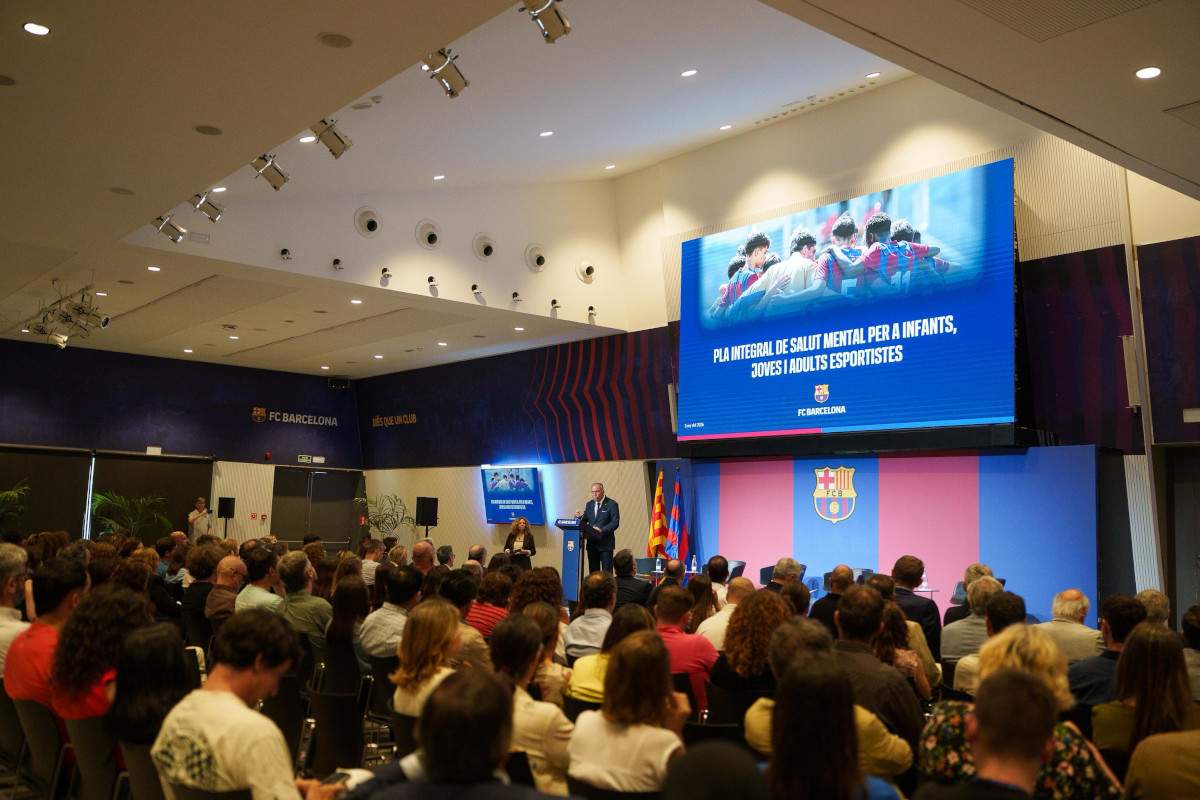
In this photo, the interim president of FC Barcelona, Rafael Yuste, can be seen addressing a big crowd (over a hundred people from sports, public administrations, social organisations, educations and, of course, mental health) at the Auditori 1988 in the Camp Nou facilities. Such a wide call, and his words that combined institutional and personal elements, convey FC Barcelona and the FC Barcelona’s firm commitment to mental health, a long-term investment to improve mental health care for children, adolescents, youth, and adults as part of their projects, programs, and activities.
The official news can be read on the FC Barcelona website and on the FC Barcelona Foundation website.
2) Working as a network, with each team having its own responsibilities.
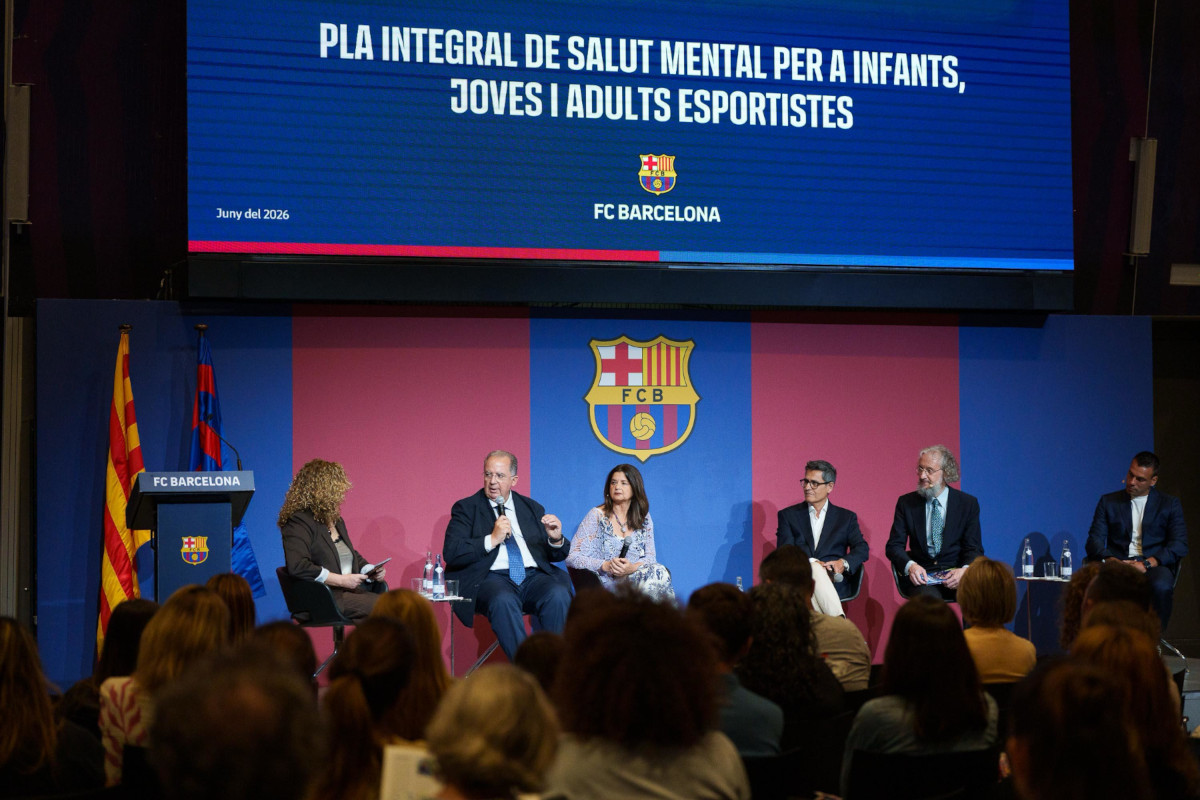
The photo shows the event’s roundtable, symbolizing the various elements and processes:
- The institutional background featuring FC Barcelona’s colors and logo, which reflects the entire organization’s commitment to this issue.
- The screen with the title of the Comprehensive Mental Health Plan for children, youth and adults, delineating the content.
- The disposition of those of us who took part, in a roundtable format that highlights collaboration and working as a network. The explanation of who each person is goes from left to right in the photograph.
- Journalist Àngels Prieto, leading the conversation on behalf of FC Barcelona, but also on behalf of the media that were present.
- Doctor Xavier Corbella, on behalf of the FC Barcelona Medical Services, as their Head, in charge of referral and triage of mental health issues.
- Doctor Marta Segú, Director of the FC Barcelona Foundation, representing FC Barcelona’s general commitment with social issues, but also the Foundation’s involvement in psychosocial projects and integration through sports, with its care for the mental health of children and young people in situations of social disadvantage.
- Doctor Josep Antoni Ramos-Quiroga, in a dual role of the Vall d’Hebron Institut de Recerca in receiving cases, as the designated public hospital, and in conducting research together with FC Barcelona in order to identify mental health problems that exist currently among athletes, especially among children and young people.
- Myself, F. Javier Romeo-Biedma, as the consultant responsible for the development of the Mental Health tools integrated in the FC Barcelona’s Child Safeguarding System.
- Former futsal player Sergio Lozano, as the representative of athletes that have had mental health problems, with a message of overcoming adversity and the importance of asking for and accepting help.
All of us, individuals and organizations, share a responsibility to do our part within our respective spheres of influence and to coordinate in an effective teamwork that serves children and young people, and their families and legal guardians.
3) A Position Statement that outlines the approach.
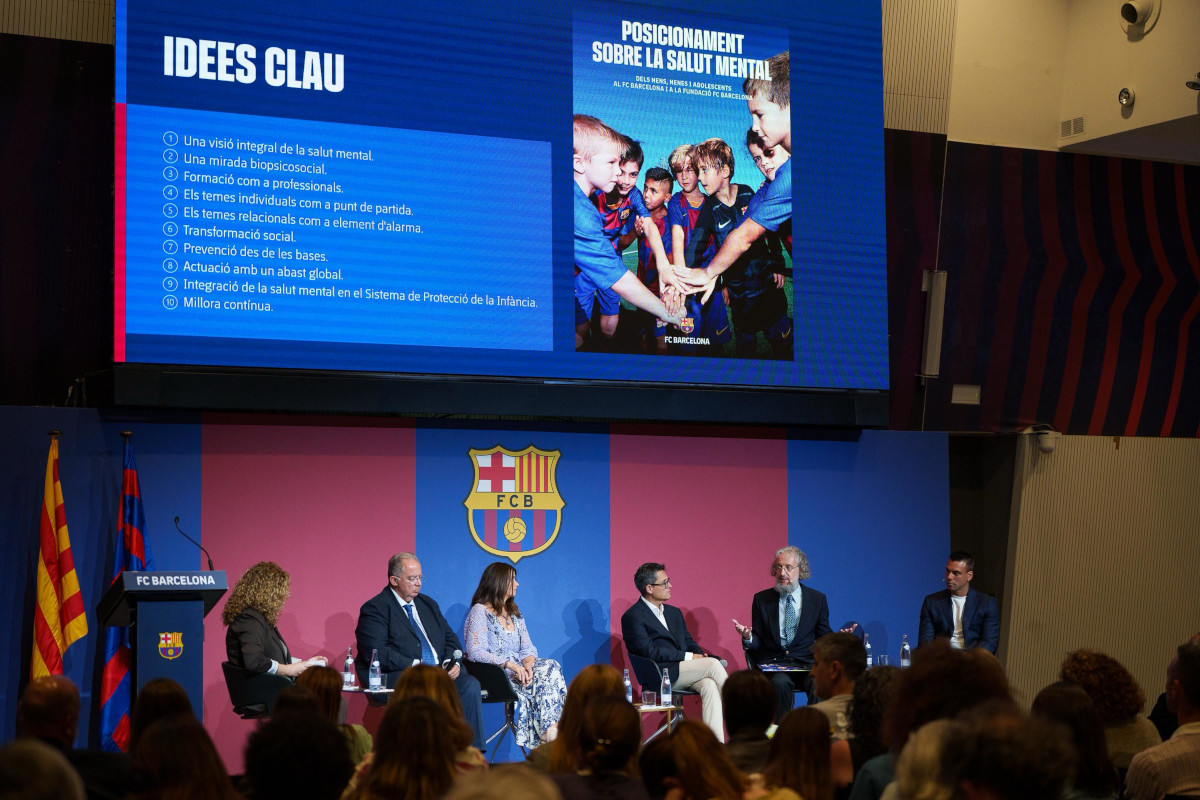
The Position Statement on the Mental Health of Children and Young People at FC Barcelona and the FC Barcelona Foundation presents succinctly the general approach to mental health through ten ideas, that we commented in the presentation, as seen in the picture. The key ideas in text, that are elaborated in the Position Statement are as follow:
- 1 A Comprehensive View of Mental Health.
- 2 A Biopsychosocial Perspective.
- 3 Professional Training.
- 4 Individual Issues as a Starting Point.
- 5 Relational Issues as Warning Signs.
- 6 Social Transformation.
- 7 Prevention from the Ground Up.
- 8 All-Encompassing Scope.
- 9 Integration of Mental Health as Part of Our Child Safeguarding System.
- 10 Continuous Improvement.
4) A Mental Health Protocol that that puts the well-being of children and adolescents at the center.
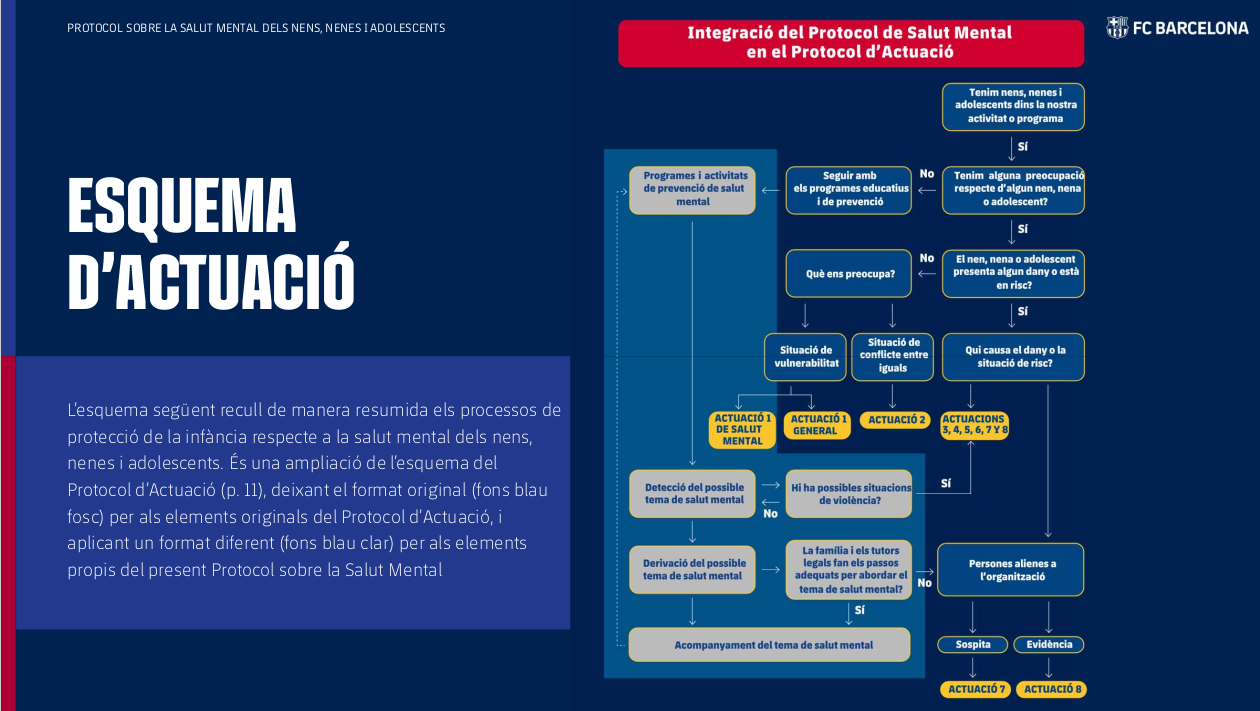
The Protocol for Safeguarding the Mental Health of Children and Young People at FC Barcelona and the FC Barcelona Foundation describes all relevant actions, from prevention to detection, referral (including triage) and support. This image that was shown (in Catalan, as was most of the event) during the presentation illustrates the framework for the integration of the Mental Health Protocol (page 13) with the Action Protocol (of the Child Safeguarding System) and it provided an explanation of the entire process, with a special focus on families. Most families express concern about the mental health of their children and adolescents, and in such cases, the primary role of institutions is to ensure that there are no related incidents of violence and to support parents or legal guardians. However, a failure to act on the part of those who should be responsible for these matters may be regarded as negligence (a form of violence), and in that case the Action Protocol would need to be activated.
5) The lineup backed by a much larger team.
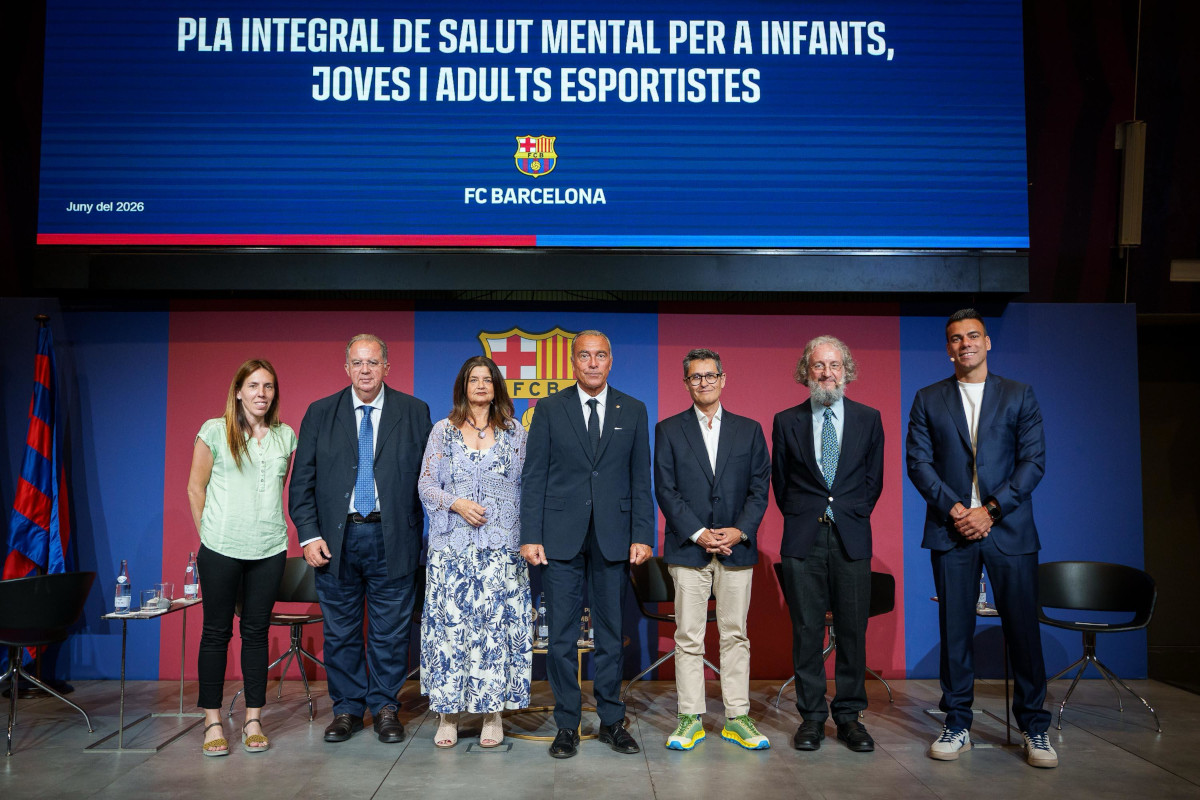
This photo really captures the idea —so common in sports— of a team lining up. From left to right, we have Marta Saula (physical therapist at FC Barcelona) and the rest of us who are mentioned in the previous photos, doctor Xavier Corbella (the FC Barcelona Medical Services), doctor Marta Segú (Director of the FC Barcelona Foundation), Rafael Yuste (interim president of FC Barcelona), doctor Josep Antoni Ramos-Quiroga (Vall d’Hebron Institut de Recerca), myself (F. Javier Romeo-Biedma, as the consultant in this process) and Sergio Lozano (former futsal player and mental health advocate in sports). As with any team, we are the members who take the field, but behind the scenes there are many more people who have been working on this project —some for years—, especially the Compliance team at FC Barcelona and the Child Safeguarding team at the FC Barcelona Foundation. I would like to take this opportunity to thank everyone for their contributions —both those that are most visible and those that are not— because without them, this project would not have been possible, or at least not with the same level of quality and attention to detail.
In conclusion, I hope that this comprehensive approach to mental health issues in Child Safeguarding Systems will spread to other organizations and other areas, with the aim of continuing to improve the care provided to children and young people in all aspects of their lives.